Global aquaculture
Production systems
Ponds, net pens, suspended lines and land-based systems: each species, environment and market calls for a different model.
World aquaculture relies on a wide range of systems. The type of farming used depends on factors such as the species, environmental conditions, climate, water availability, available technology, the target market and the level of investment.
That is why farming seaweed, shellfish, shrimp, tilapia or salmon calls for different production systems. Some organisms can grow on nutrients naturally present in the environment, while others need formulated feed, health management and constant water quality monitoring.
Pond farming
Ponds and tanks are among the most widely used systems in world aquaculture, especially for species such as carp, tilapia and shrimp.
They can use freshwater or brackish water and involve different levels of management, from systems that rely mostly on the natural productivity of the environment to operations with feeding, aeration, monitoring and higher stocking densities.
Their design and management depend on the species farmed and the production conditions of each area.
Floating net pens
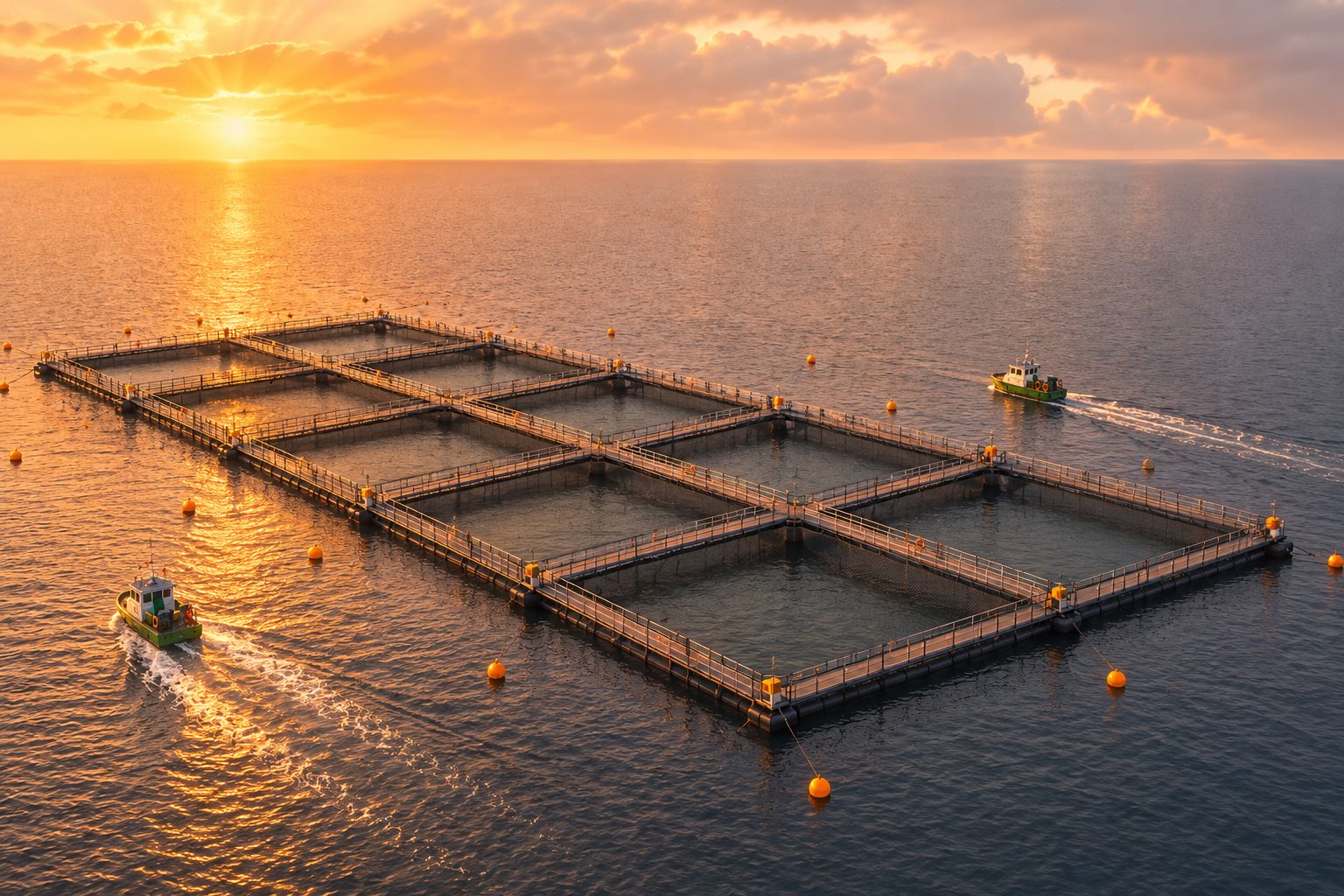
Floating net pens make it possible to farm fish directly in bodies of water such as:
- lakes;
- reservoirs;
- coastal areas;
- marine environments.
In these systems, fish are held inside net structures while water flows naturally through them.
This type of system is used, for example, to farm salmon and other finfish species.
Because it is directly connected to the environment, its performance depends closely on factors such as water quality, currents, temperature, available oxygen and the health conditions of the surrounding area.
Suspended lines and floating structures
Shellfish and seaweed farming often uses systems different from those used for finfish.
Suspended lines, ropes, collectors and other floating structures let these organisms grow attached to them or hanging in the water column.
This type of system is especially suited to species that take their nutrients naturally from the environment, such as filter-feeding shellfish and seaweed.
So not every aquaculture crop needs artificial feed.
Land-based production systems
Aquaculture can also take place entirely on land, in facilities designed to control the farming environment more precisely.
These systems include:
- raceways, or continuous-flow channels;
- circular tanks;
- facilities with water treatment;
- recirculating systems.
These models make it possible to manage variables such as temperature, oxygen, water quality, stocking density and health conditions with a different level of control than open systems allow.
Recirculating systems: RAS
Recirculating Aquaculture Systems (RAS) treat and reuse much of the water within a facility.
This allows farming under more controlled conditions and reduces the need to keep replacing large volumes of water.
RAS is one of the technologies gaining importance in aquaculture, especially in intensive systems and in production stages where environmental and health control is essential.
Extensive, semi-intensive and intensive systems
Aquaculture systems can also be classified by how intensive they are.
Extensive systems
They work with low stocking densities and rely mostly on the natural productivity of the environment.
Technological input and supplementary feeding are usually limited.
Semi-intensive systems
They use higher stocking densities and more frequent management.
They may use supplementary feeding and more control over production conditions.
Intensive systems
They aim for higher production per unit of area or volume.
To do so, they require more complex management, which can include:
- formulated feed;
- oxygen control;
- constant water quality monitoring;
- disease prevention;
- technology;
- greater technical capacity.
Intensity, then, refers to more than producing more organisms. It also describes the level of management and control needed to sustain that production.
Each species needs a different system
Not all farmed organisms have the same needs.
Filter-feeding shellfish and seaweed can grow on nutrients already present in the water.
Many finfish and crustaceans, on the other hand, need:
- formulated diets;
- health management;
- environmental control;
- growth tracking;
- monitoring of farming conditions.
This means the choice of production system cannot be separated from the biology of each species.
Production starts before grow-out
For many species, the production cycle begins in specialized facilities known as hatcheries.
Stages carried out there can include:
- broodstock management;
- fertilization;
- incubation;
- larval production;
- juvenile production.
The quality of these early stages is critical because it sets the starting condition of the organisms that will later be moved to ponds, net pens, farming lines or other production systems.
For more complex species, gaining full control of the farming cycle can take years of research, technology development and production adaptation.
Technology and control
As production intensity increases, so does the need for monitoring and technology.
Modern aquaculture can use tools to control:
- water quality;
- oxygen;
- temperature;
- feeding;
- growth;
- the health of the organisms;
- environmental conditions.
The goal is to keep conditions right for each species and make more efficient use of available resources.
The choice of production system therefore depends on more than where the farming takes place. It also depends on the level of control, investment, knowledge and technology required.