
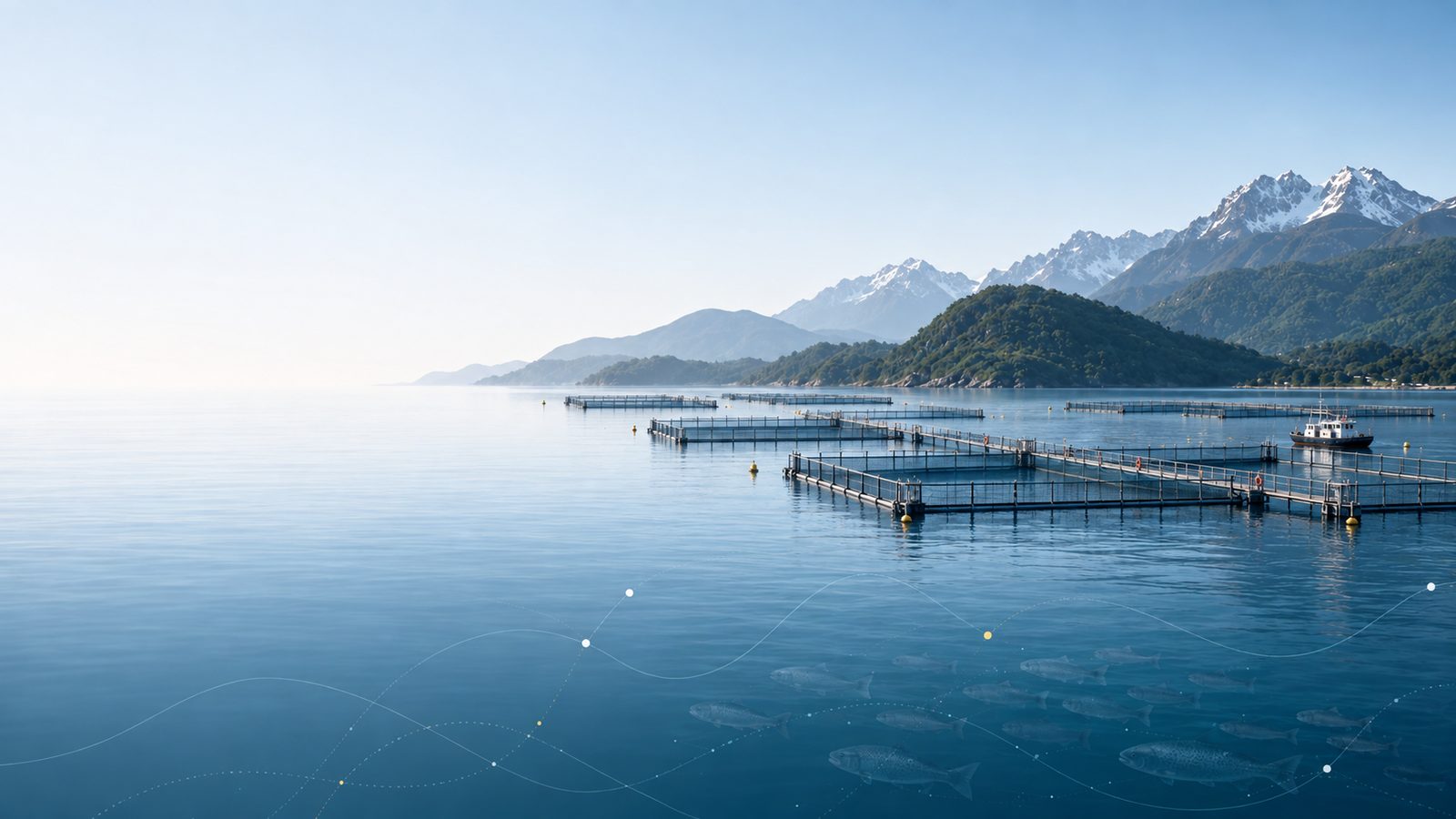
Salmon farming in Chile
Regulation and monitoring
Chilean salmon farming operates under fish health, environmental and operational regulation, with continuous monitoring and strict certification systems.
What is monitoring?
Salmon farming takes place in a dynamic environment, where water conditions, fish health and the surroundings can change constantly, over time and space. For this reason, ongoing monitoring is one of the pillars of the activity.
Monitoring means systematically observing, measuring, recording and analyzing different aspects of farming to understand what is happening at each stage of the process. This information makes it possible to detect changes early, prevent risks and make evidence-based decisions.
Unlike an occasional inspection, monitoring is part of the daily operation of salmon farming and runs through the entire production cycle.
What is monitored?
Monitoring covers different aspects that, together, make it possible to assess the condition of the fish and of the environment where farming takes place.
The main aspects monitored include:
- fish health;
- the presence of diseases of concern;
- environmental conditions at the farm site;
- sediment and benthic environment variables;
- in certain cases, water column variables;
- operational conditions relevant to farming;
- product stock;
- market fluctuations (prices, volumes, etc.).
Tracking this information continuously makes it possible to understand how the farm site and its buyers change over the production cycle, and to act promptly when needed.
Fish health monitoring
One of the main goals of fish health monitoring is to keep constant track of the health status of the fish and the effectiveness of vaccines and drugs.
To do this, continuous surveillance is kept on diseases of concern, health risks and various operational conditions related to production.
This information makes it possible to detect health problems early, coordinate preventive measures and strengthen farm site management.
Fish health monitoring is not carried out only site by site. In Chile, nearby sites also coordinate through Salmonid Concession Groupings (Agrupaciones de Concesiones de Salmónidos, ACS), known in the industry as “neighborhoods”.
These groupings make it possible to coordinate aspects such as production cycles per site, fallowing periods and other measures meant to reduce the risk of disease transmission between neighboring sites.
Environmental monitoring
Besides fish health, salmon farming keeps ongoing track of the environmental conditions where each farm site operates.
This monitoring seeks to verify that the surroundings remain compatible with the activity and to detect possible changes in the ecosystem early.
One of the main instruments used in Chile is the INFA (Información Ambiental, an environmental information report), an assessment required by the Environmental Regulation for Aquaculture (Reglamento Ambiental para la Acuicultura).
The INFA is carried out when the site reaches its maximum biomass, that is, when the number of fish and the environmental load on the site are at their highest.
Depending on the characteristics of the site, this assessment mainly considers:
- variables describing the environmental condition of the sediments;
- conditions in the benthic environment (the seabed);
- and, in some cases, water column variables.
What does an aerobic or anaerobic INFA mean?
INFA results show the environmental status of the area where a farm site operates.
When the result is aerobic, the site maintains environmental conditions compatible with continued operation.
When the result is anaerobic, however, the site cannot stock fish again until a new assessment shows that the area has recovered adequate conditions.
In this way, the INFA provides environmental information and also serves as a tool for regulatory decisions.
Who uses this information?
The information gathered through monitoring serves several purposes.
Companies use it to manage their farm sites, evaluate production performance and take preventive measures when needed.
At the same time, public bodies such as SERNAPESCA and the environmental authority use part of this information for fish health surveillance, enforcement and oversight of the activity.
Together, this information strengthens coordination between companies and authorities, supporting management based on objective, up-to-date data.
Prevention, not just control
Monitoring is not only about checking whether a rule is being followed.
Its main value lies in anticipating risks, supporting decision-making and contributing to the continuous improvement of salmon farming.
The information collected makes it possible to coordinate fish health actions, assess the environmental status of farm sites and strengthen prevention against challenges that could affect both the fish and their surroundings.
In this sense, monitoring is one of the main tools for moving toward increasingly responsible and sustainable production. Data collected over time feed predictive models that issue disease alerts and prompt preventive measures against outbreaks.