Global salmon farming
How salmon are farmed
Salmon farming combines freshwater hatcheries, biology, nutrition, monitoring and marine production.
A cycle that begins in freshwater
Salmon farming reproduces, under controlled conditions, a biological trait specific to salmonids. In the wild, these fish hatch in freshwater, migrate to the sea to grow and, once mature, return to rivers to spawn.
Salmon farming builds on this natural cycle through production systems that combine freshwater facilities and marine farm sites. That is why the process does not begin in the ocean, but in freshwater hatcheries specially prepared for the fish's early life stages. These early stages take place in water at temperatures typical of high latitudes (cold).
Spawning and egg incubation
The process begins with broodstock selection and egg fertilization. Once fertilized, the eggs are kept in incubation systems where factors such as temperature, oxygen and water quality are carefully controlled.
After hatching come the alevins, which keep growing and developing until they become juvenile fish. During this early stage, they need stable environmental conditions, proper feeding and strict health control.
Freshwater hatcheries use continuous monitoring systems to control variables such as:
- dissolved oxygen;
- temperature;
- water flow and quality;
- feeding;
- fish health status.
These variables are essential because what happens during the freshwater stage directly affects the fish's later ability to adapt and develop in the marine environment.
Freshwater hatcheries and recirculation systems
The early stages of farming can take place in flow-through hatcheries or in water recirculation systems, known as RAS, short for Recirculating Aquaculture Systems.
In these systems, most of the water is treated and reused within the facility. This allows more precise control of the environmental and health conditions of the water, regulating variables essential to fish development.
RAS technology has become increasingly important in producing juveniles and smolts, since it allows better control of the environment in which the early stages of the cycle take place, while ensuring good environmental quality in the water returned to the source water body (usually a river).
Smoltification: getting ready for life at sea
As the fish grow, they go through a physiological process called smoltification. During this stage they undergo hormonal, metabolic and morphological changes that allow them to adapt to the move from freshwater to saltwater.
Once the fish completes this process it is called a smolt and is ready to be transferred to the marine environment. Reaching a certain size is therefore not enough: it must also have developed the physiological capacity to properly regulate the balance of water and salts in its body.
This transition is one of the most delicate stages of the production cycle. The health and physiological condition of the smolt will later influence its adaptation to the sea, its growth, its resistance to stress and its performance during grow-out.
Transfer to marine farm sites
Once smolts reach the right size and physiological condition, they are transported to farm sites in marine areas with favorable conditions, such as fjords, channels and sheltered bays with good water circulation, which have been expressly authorized under the regulations of the country concerned.
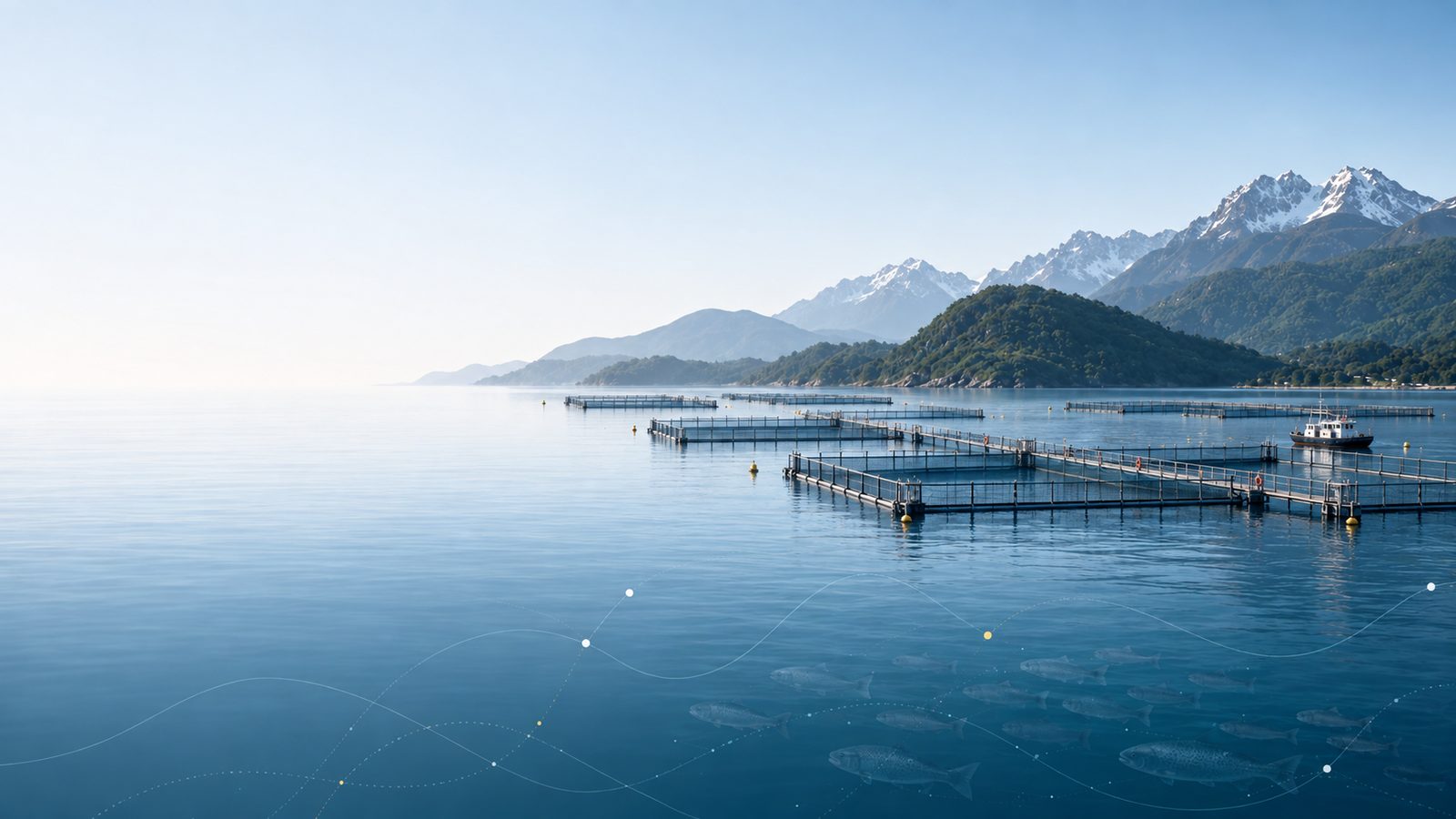
At these sites, the fish are kept in floating structures known as net pens. These facilities are surrounded by nets that hold the fish and allow natural water exchange with the surroundings.
Transport and transfer to sea must be done carefully, keeping stress low and making sure the fish enter the new environment in good condition.
The growth phase at sea
The marine stage is the period when most of the salmon's growth takes place. During this phase, the fish receive balanced feeds formulated specifically to meet their nutritional needs.
These diets contain proteins, oils, vitamins, minerals and other nutrients needed to support:
- growth;
- health;
- fish welfare;
- immune response;
- efficient use of feed.
Feeding is adjusted by species, age, size and production conditions. Diets and ingredients are covered in detail in the feed and efficiency section.
How long does farming take?
The length of the cycle is not exactly the same for all salmon. It depends on several factors, including:
- species;
- genetics;
- water temperature;
- feed quality;
- health management;
- environmental conditions;
- production strategy.
As a general reference, Atlantic salmon can complete its production cycle in roughly two to almost three years, from egg fertilization to harvest. However, this period can vary between regions, farming systems, production conditions and target harvest size (usually 5-6 kg).
It is also increasingly common to use RAS systems that move from brackish water to saltwater to grow smolts on and extend their time in tanks (up to 300 to 600 g) before they go to sea. This makes it possible to stock sturdier fish and shorten the seawater phase, where health and environmental risks are greater.
In addition, several companies around the world have already developed full-cycle RAS sites, through to harvest, to manage farming conditions more broadly and strictly. However, this system carries other risks that have so far kept it from displacing semi-open grow-out farming at sea (net pens).
Technology and continuous monitoring
Modern salmon farming uses a range of tools to observe fish behavior, control environmental conditions and improve farming efficiency.
These technologies include:
- underwater sensors;
- underwater cameras;
- automated feeding systems;
- data analysis;
- artificial intelligence;
- oceanographic modeling.
These tools make it possible to monitor in real time aspects such as water quality, feeding behavior, fish growth and environmental conditions, and to predict some of them (with more or less accuracy, depending on the quality of data and models), namely feeding and growth rates, and weather and ocean conditions. This way, teams can make more timely decisions and adjust management to what is happening at each site.
Fish health and welfare
Fish health and welfare are central throughout the production cycle. Fish can face infectious diseases, parasites, environmental changes, harmful algal blooms and other situations that affect their condition and growth.
To prevent and manage these risks, salmon farming has adopted advances in:
- vaccination;
- biosecurity;
- genetics;
- diagnostics;
- epidemiological monitoring;
- health surveillance;
- environmental surveillance.
Caring for fish does not begin when health problems appear. It is built from the earliest stages through proper water quality, nutrition, handling, stocking density, prevention and constant observation.
Harvest and processing
When salmon reach the right weight and condition for sale, the harvest stage begins. They are then taken to processing plants, where they are prepared under controlled quality and food safety conditions.
Salmon can be sold in different formats, including:
- fresh;
- frozen;
- fillets;
- smoked;
- portions;
- higher value-added products, such as ready-to-eat products.
After processing, products are distributed through land, sea and air logistics chains to markets and consumers in different parts of the world.
In this way, farming does not end when the fish leave the marine farm site. It also includes processing, preservation, transport, traceability and distribution.
A biological and technological process
Salmon farming is an integrated process that combines the fish's biological needs with scientific knowledge, production technologies, health control and environmental management.
From egg fertilization to the product reaching the consumer, each stage affects the next. The quality of juveniles affects their performance at sea; feed influences their growth and health; environmental conditions affect fish welfare; and monitoring allows management decisions to be adjusted in time.
In countries such as Norway and Chile, this activity has reached a high level of technical development and integration, combining science, innovation, nutrition, animal health, sustainability and international trade.