
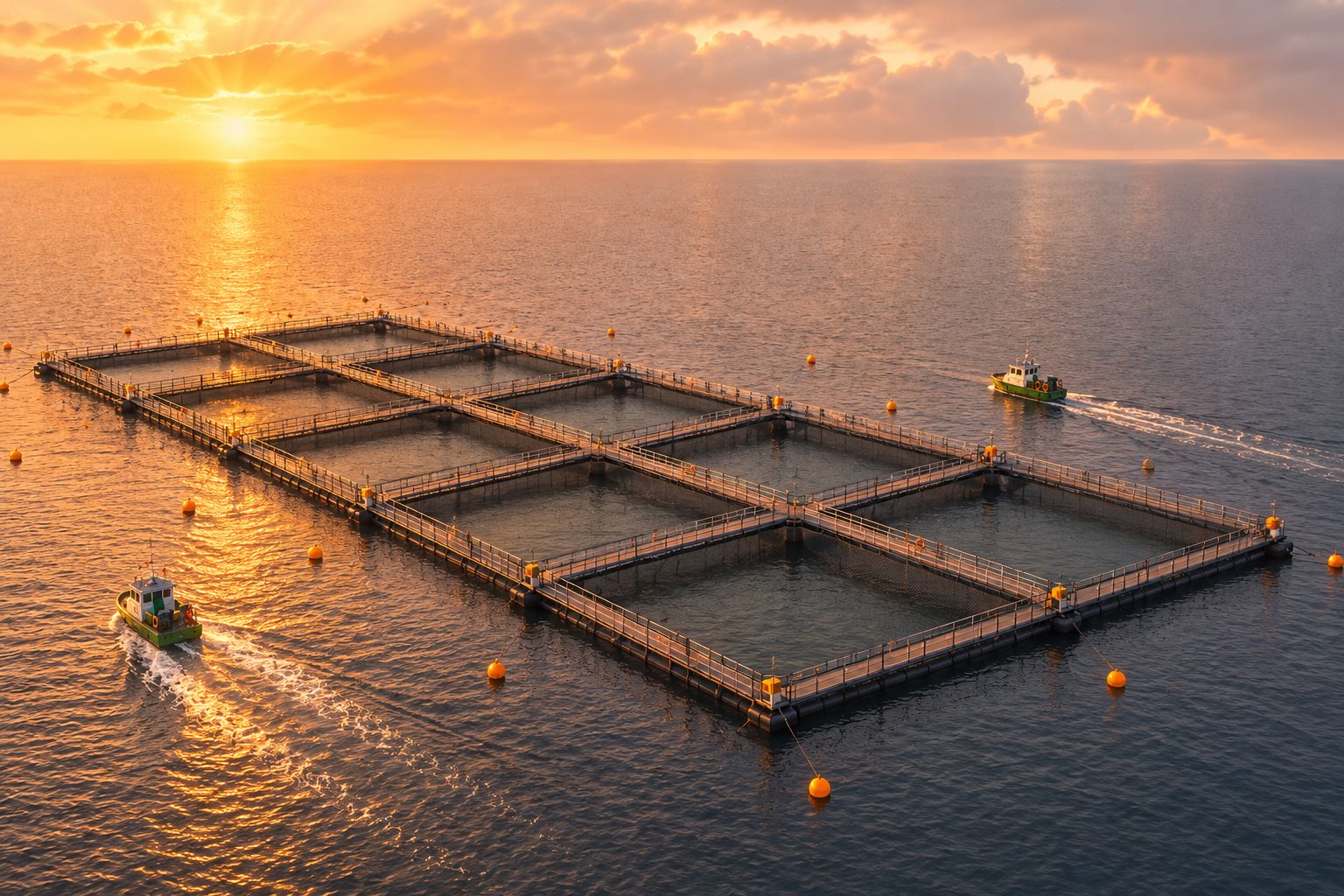
Global aquaculture
Food supply
Aquaculture's contribution to food security is not measured in tonnage alone: access, price, diversity and sustainability matter too.
A growing source of food for the world
Over recent decades, world population growth, rising incomes and higher demand for protein have increased the need to produce food efficiently and sustainably.
In this setting, aquatic food has become increasingly important. Finfish, shellfish, crustaceans and seaweed provide high-quality protein, essential amino acids, minerals, vitamins and fatty acids that benefit human health.
The Food and Agriculture Organization of the United Nations (FAO) estimates that billions of people get a significant share of their animal protein and micronutrients from aquatic food, especially in coastal regions and developing countries.
More than half already comes from aquaculture
The expansion of aquaculture has changed how this food reaches people.
According to FAO, more than half of the aquatic food people eat today comes from aquaculture.
This shift matters because for much of the 20th century the main source of aquatic food was capture fisheries. As many of them began to hit limits tied to how fast wild populations can recover, aquaculture took on an ever larger role in the world's supply.
Food security: much more than tonnage
Aquaculture's contribution to food security cannot be measured only by the amount of food it produces.
It also depends on factors such as:
- access;
- distribution;
- prices;
- sustainability;
- species diversity;
- nutritional value.
This means that producing more food does not, on its own, guarantee that it reaches the people who need it.
Food security requires availability, along with economic access, adequate distribution and production systems that can last over time.
Different systems, different contributions
Aquaculture contributes to food supply in very different ways depending on the region and the type of production.
In many countries in Asia and Africa, small-scale aquaculture plays an especially important role in:
- household nutrition;
- rural income;
- poverty reduction;
- food resilience.
Higher-value species, such as salmon, shrimp and some marine species, go mainly to urban and international markets.
So aquaculture's contribution is not uniform: it can feed a household, supply local markets or be part of international food chains.
An efficient way to produce protein
Several aquatic species have production advantages over many land-based animal production systems.
These advantages include:
- good feed conversion ratios;
- lower freshwater use in certain systems;
- lower relative energy needs to produce animal protein.
Feed conversion estimates how much feed is needed to produce a given amount of animal weight. Better conversion means using less feed for the same amount of growth.
This efficiency has fueled growing interest in aquaculture in international discussions on sustainable food production.
Producing food also means using resources
Production efficiency does not mean aquaculture is free of impacts.
The environmental outcome depends on, among other factors:
- the species farmed;
- the production system;
- the origin of the ingredients used in feed;
- energy use;
- health management;
- environmental quality;
- transport;
- the technology used.
That is why aquaculture growth has to go hand in hand with improvements in environmental sustainability, animal welfare, health management, governance and efficient use of resources.
Aquatic food and nutrition
The food value of aquaculture also lies in the variety of organisms it can produce.
Aquatic food can provide:
- high-quality protein;
- essential amino acids;
- vitamins;
- minerals;
- essential fatty acids.
This contribution is especially relevant for populations where aquatic products are a regular part of the diet and an important source of micronutrients.
For this reason, aquaculture should be seen as more than a production industry. It is also part of the world's food and nutrition systems.
The challenge ahead
Aquaculture's ability to contribute to the world's food supply will depend on how it continues to develop.
Production growth will need to come with improvements in:
- sustainability;
- efficiency;
- adaptation to climate change;
- animal health;
- food availability;
- equity;
- access to products.
The challenge, then, goes beyond producing more aquatic food. It is about doing so through sustainable, resilient and accessible systems.