
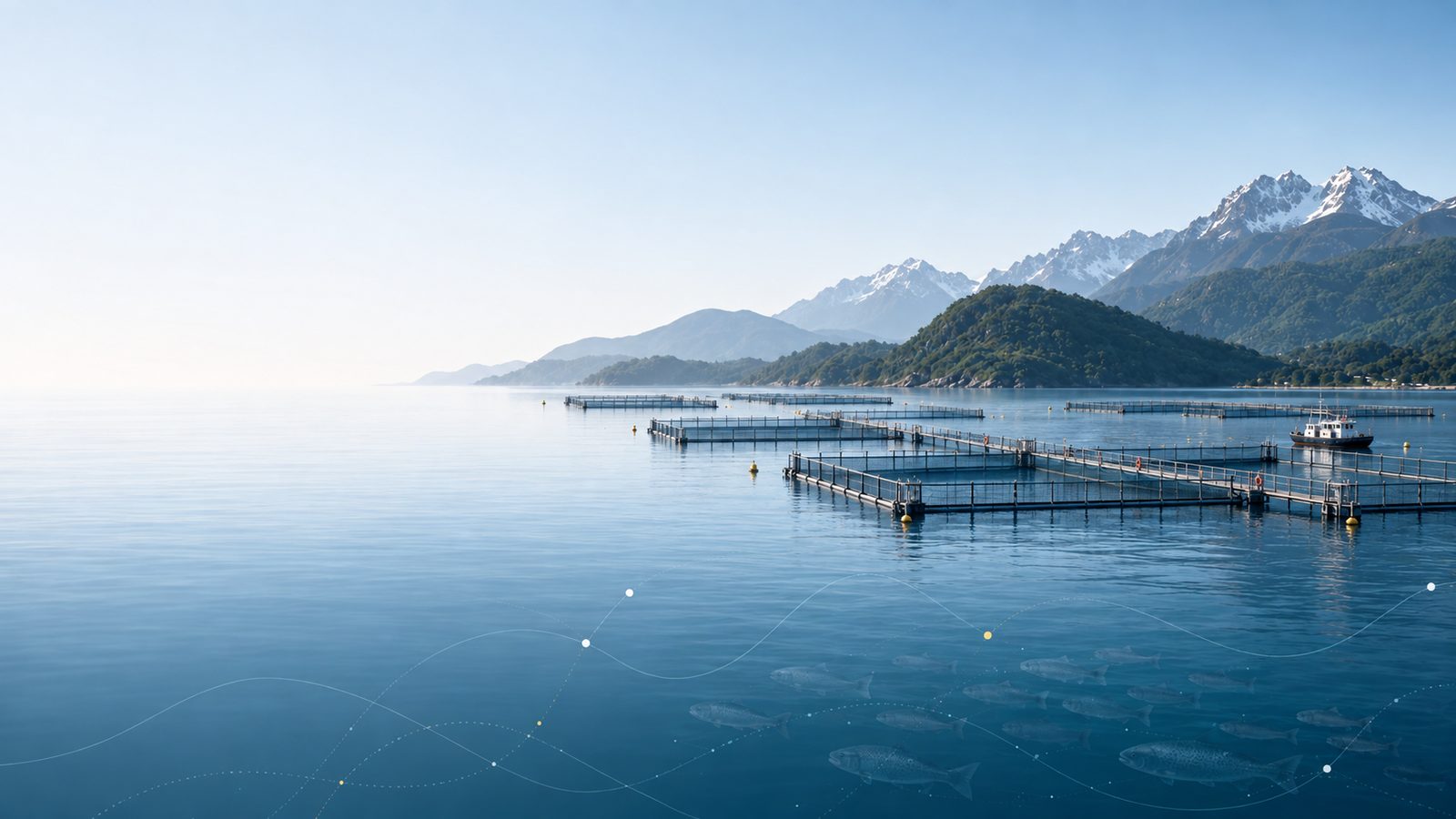
Salmon farming
Salmon farming in Chile
A branch of aquaculture devoted to farming salmon and trout, and one of the most important productive activities in southern Chile.
What is salmon farming?
Salmon farming is a branch of aquaculture devoted to raising salmon and trout under controlled or semi-controlled conditions.
Its goal is to produce food in a planned way, following the growth of the fish from their earliest life stages until they reach the right size for harvest.
Unlike capture fisheries, where fish are caught directly from the wild, salmon farming raises fish through a process that takes into account their feeding, welfare, health and development throughout their life cycle. In salmon farming, high growth performance and quality are not conceivable if fish health and welfare are ignored, so the best knowledge available at the time is applied.
The activity draws on biology, veterinary medicine, oceanography, engineering, nutrition, genetics, environmental science and technology, digital technologies and artificial intelligence, among other fields, which makes it the most advanced and specialized branch of aquaculture.
How did salmon farming begin in Chile?
Although Chile is now internationally recognized for its salmonid production, the farmed species, essentially three, are not native to the country.
The first attempts began with the introduction of trout, both rainbow and brown, toward the end of the 19th century, through imports of eggs from Europe and North America. At first, these initiatives aimed to stock rivers and lakes to promote sport fishing and to study how these species adapted to the natural conditions of southern Chile.
Over the decades, various public institutions, research centers and companies began running increasingly successful farming trials. Early on they focused on producing smolts to release into rivers, wait out their long migrations and create a new fishery in Chile's far south. Despite good return rates, legal issues and the lack of an attractive payback for those who invested in producing the smolts led to the idea being dropped. Later advances made it possible to better understand salmon biology, refine production techniques and lay the foundations of an industry that would grow steadily through farming in captivity (net pen systems at sea).
Why did Chile become a world leader?
The development of salmon farming was no accident. It came from a combination of several factors.
On one hand, southern Chile offers especially favorable natural conditions for farming salmonids: cold water, abundant fjords and channels, good water quality and oceanographic features that support the growth of these species.
Added to this were investment in research, the adoption of new technologies, the training of specialized human capital and the development of a broad network of companies supplying goods and services to the industry, which grew stronger over time with different areas of specialization and technological sophistication.
As a result of this process, in just 20 years Chile became the world's second-largest producer of farmed salmonids and one of the largest exporters of this food to international markets.
Where does salmon farming take place?
The activity is concentrated mainly in the Los Lagos, Aysén and Magallanes regions, where environmental conditions favor salmon farming.
These territories host the different stages of the production process, including freshwater hatcheries, sea farm sites, processing plants, laboratories, research centers and an extensive network of supplier companies.
Salmon farming has contributed to the economic and social development of southern Chile by creating jobs, infrastructure, specialized services, higher education and new advanced technical skills.
Which species are farmed in Chile?
Chilean salmon farming is based mainly on three species:
Atlantic salmon (Salmo salar)
It is the most produced species in Chile and the most in demand in international markets, consistently accounting for about two-thirds of the country's salmonid production.
Coho salmon (Oncorhynchus kisutch)
It stands out for its production cycle and for supplying a range of export markets, and it has grown considerably since 2002.
Rainbow trout (Oncorhynchus mykiss)
Its production has declined amid growing international competition, but its quality is still valued in many markets around the world.
Although they differ somewhat biologically, all three species require specialized and similar management throughout the different stages of their development.
An industry that goes far beyond farming fish
Salmon farming brings together hundreds of companies and institutions that take part in different stages of the production chain.
Besides farm sites, the chain includes laboratories, feed companies, technology firms, shipyards, transport operators, universities, research centers, public agencies and many specialized suppliers.
That is why salmon farming does more than produce food: it also drives scientific research, technological innovation and the growth of many economic activities linked to the sea.