
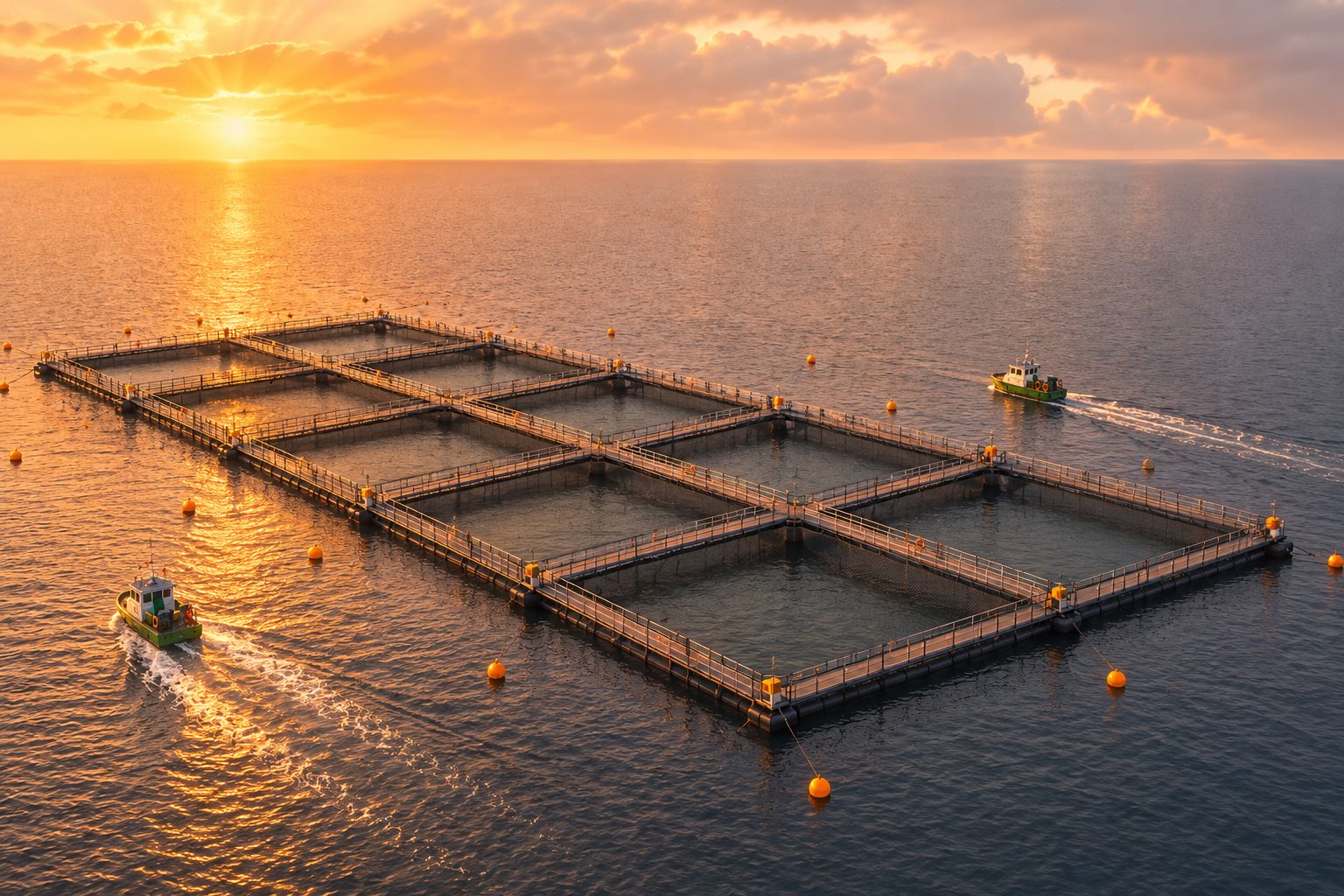
Aquaculture
Aquaculture in Chile
Chile is one of the leading aquaculture countries in Latin America: it produces food, creates jobs and supports a network of suppliers, science and technology.
Chile is one of the leading aquaculture countries in Latin America and a significant player in global aquaculture.
Over recent decades, the country built a highly specialized activity aimed mainly at international markets. Besides producing food, it creates jobs, sustains exports and drives a wide network of suppliers, technical services, logistics, applied research and specialized technology.
Its development has centered on three large groups: finfish, shellfish and seaweed, although each one covers a variety of species, scales and production systems.
How much does Chilean aquaculture produce?
According to the Fisheries and Aquaculture Sector Report from the Undersecretariat for Fisheries and Aquaculture (SUBPESCA), December 2025 edition, Chile's aquaculture harvests that year reached about 1,502,000 metric tons, 5.8% more than in 2024.
Of that total:
- 76.3% was finfish;
- 22.9% was shellfish;
- 0.7% was seaweed.
These figures show the scale the activity has reached. They also show an important feature of Chilean aquaculture: although the country has the natural conditions for many kinds of farming, production remains heavily concentrated in a few groups and species.
Much more than salmon
Salmon farming is the best-known aquaculture activity in the country and the one with the highest economic value, but Chilean aquaculture produces more than salmon.
It also includes the farming of:
- choritos, or Chilean mussels;
- macroalgae such as pelillo;
- scallops;
- oysters;
- and other species that have been part of research and diversification projects.
Chile stands out internationally for more than its salmonid production: it is also recognized as the world's second-largest mussel producer and a significant player in macroalgae farming.
The range of farmed species is covered in more detail in the farmed species section.
An activity shaped by geography
Chilean aquaculture has a strong regional footprint.
Most production takes place in the south of the country, especially in the Los Lagos, Aysén and Magallanes regions. There, the geography of fjords, channels and sheltered waters, together with oceanographic conditions and water availability, has favored the growth of aquaculture.
But Chilean aquaculture is not limited to the far south. Other parts of the country have also developed shellfish and seaweed farming, including scallops in the north and a range of aquaculture projects along the Chilean coast.
Chile's development therefore reflects a mix of natural, institutional, technological and economic conditions. These factors include:
- the country's long coastline and maritime geography;
- the fjords and channels of the far south;
- the availability of freshwater;
- favorable oceanographic conditions;
- and the gradual development of scientific and production capabilities.
An industry that grew alongside a supplier ecosystem
One of the most important effects of Chile's aquaculture development has been the creation of capabilities that reach well beyond the farm sites themselves.
Around the activity, a supplier industry has taken shape, offering specialized technology and services in areas such as:
- net pens, nets, packaging and materials;
- refrigeration systems;
- metalworking and metal fabrication equipment;
- electronics;
- lighting;
- renewable energy;
- environmental consulting;
- aquaculture system design;
- genetics;
- stocking;
- technology solutions and consulting.
In this way, the growth of aquaculture has also driven technological innovation, scientific research, logistics, specialized services and regional capabilities.
From early production trials to international scale
Chilean aquaculture did not develop overnight. Over the last five decades, the country built the production, scientific, business and logistics capabilities that turned early experimental projects into industries with international reach.
Salmon farming is probably the most visible example: within a few decades, Chile went from experimental farming trials to becoming the world's second-largest producer of farmed salmon, after Norway. At the same time, it built a large mussel farming industry, concentrated mainly in the Los Lagos Region, which also gained a significant position in international markets.
This growth explains why the Chilean experience has been studied as a case of fast aquaculture development, integration into global markets and the building of production capabilities around marine and aquatic resources.
An activity that also faces challenges
The growth achieved does not mean the development of aquaculture is settled.
It faces major challenges related to:
- climate change;
- innovation;
- sustainability;
- international competitiveness;
- animal health;
- regulatory adaptation.
For Chile, the challenge goes beyond keeping production levels where they are. It means continuing to develop an aquaculture that combines competitiveness, scientific knowledge, technological innovation and sustainability.