
Aquaculture
Global aquaculture
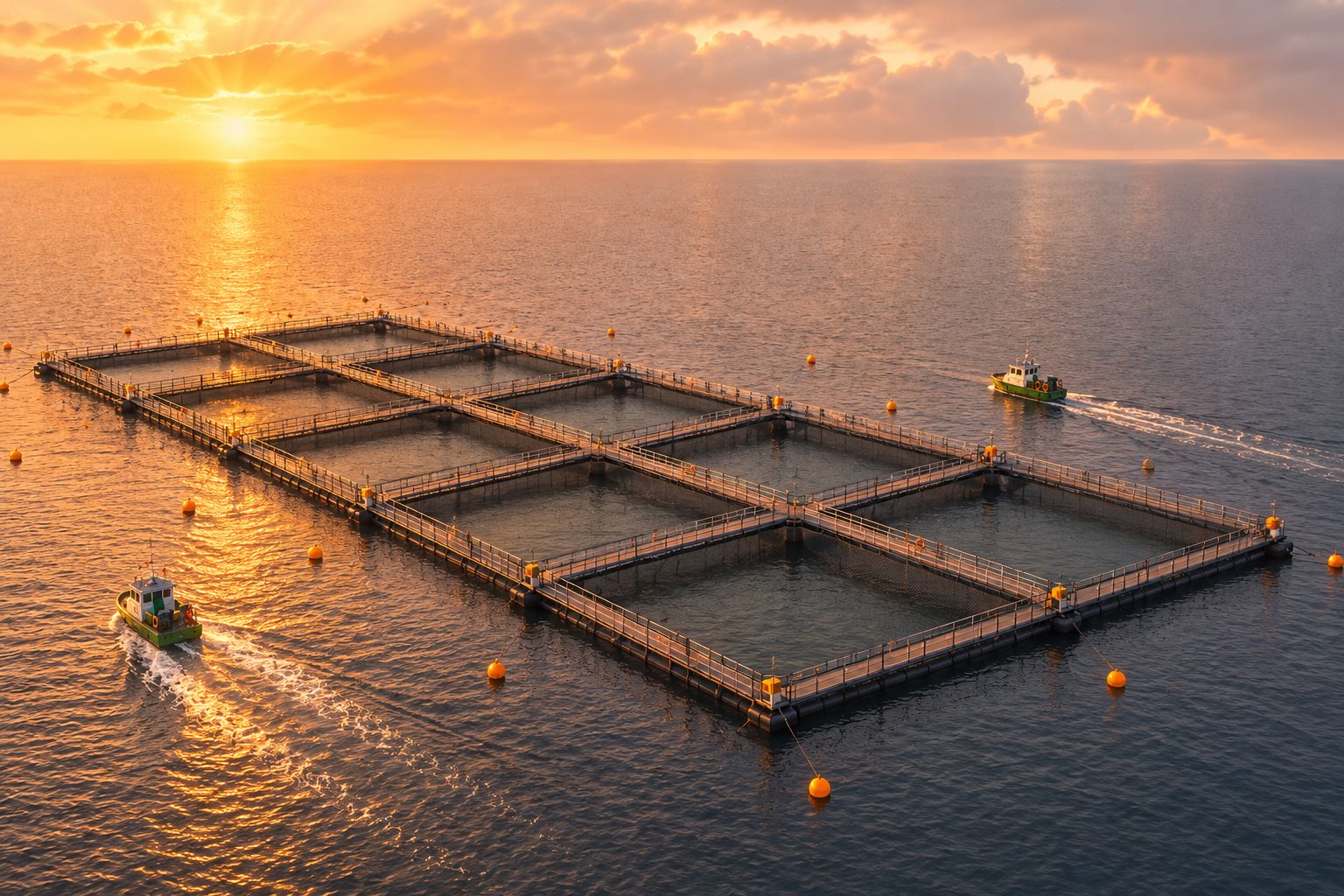
Aquaculture is the farming of aquatic organisms under conditions controlled to some degree by people, in freshwater, brackish water or seawater.
What is aquaculture?
Aquaculture is the farming of aquatic organisms under conditions controlled to some degree by people. It includes finfish, shellfish, crustaceans, seaweed and other organisms that can be produced in freshwater, brackish water or seawater.
Unlike capture fishing, which takes organisms directly from wild populations, aquaculture makes it possible to manage different stages of the production cycle, such as breeding, production of juveniles or seed, feeding, growth, harvest, processing and sale.
There is also no single way to practice aquaculture. Farming ranges from fairly simple, small-scale systems to highly technical facilities serving large markets. This diversity lets production adapt to different species, environments and local conditions.
Aquaculture can be classified in several ways: by how intensive it is, by the type of water body it uses, by distance from the coast (in the case of mariculture), and by other names based on the taxonomic group being farmed.
An activity that has grown fast
Over recent decades, aquaculture has grown steadily and become an increasingly important part of the world's food supply.
According to the Food and Agriculture Organization of the United Nations (FAO), in its report The State of World Fisheries and Aquaculture 2024, world aquaculture production reached a record 130.9 million metric tons in 2022, up from 122.8 million in 2020.
Of that total:
- 94.4 million metric tons were aquatic animals;
- 36.5 million metric tons were algae.
The estimated value of world aquaculture production reached US$312.8 billion in 2022.
These figures show the size of an activity that now holds a central place in the world's food systems.
A historic milestone: aquaculture overtook fishing
2022 was a particularly important year for world production of aquatic food.
According to FAO, for the first time in history, production of aquatic animals from aquaculture exceeded capture fisheries.
Aquaculture reached 94.4 million metric tons of aquatic animals, compared with about 91 million metric tons from capture fishing.
Farmed aquatic animals (excluding farmed algae) thus made up 51% of world production and reached a record 57% of the production destined for human consumption.
This shift is a structural change in how the world gets its aquatic food. For much of the 20th century, most of it came from capture fisheries. As aquaculture has grown, farming systems have taken on an ever larger role in the world's food supply.
Where does aquaculture take place?
Aquaculture production is not spread evenly around the planet.
Asia accounts for most of the world's production and was responsible for about 88% of the net increase in farmed aquatic animals between 2020 and 2022. China is the leading producer, followed by countries such as India, Indonesia and Vietnam.
In that region, freshwater farming, ponds, polyculture, coastal shrimp production and systems that supply large domestic markets are especially important.
In Europe, aquaculture is more often associated with technical systems, medium and large companies, environmental regulation, certifications and a growing use of technology.
In Latin America, by contrast, growth has been driven mainly by export-oriented species, including salmon, shrimp and some shellfish.
These differences show that world aquaculture does not follow a single production model: it ranges from small rural producers growing for their own use or local markets to highly technical industries built into global export chains.
Freshwater, coasts and oceans
Aquaculture can also be classified by the environment where it takes place.
According to data compiled by FAO for 2022, inland aquaculture (freshwater or brackish) supplied 62.6% of farmed aquatic animals worldwide, while marine and coastal aquaculture accounted for 37.4%.
So although we often picture aquaculture as facilities out at sea, most of the aquatic animals farmed in the world come from inland systems.
Much more than finfish
World aquaculture covers a huge variety of species.
Finfish species farmed include:
- carp;
- tilapia;
- catfish;
- salmon;
- trout.
Among crustaceans, shrimp stands out, while shellfish include oysters, mussels, clams and scallops.
Seaweed is also a large part of world production and can be used for food, as an industrial raw material and for developing new products.
This diversity shows that world aquaculture is much broader than the picture we usually have from Chile, where the activity is mostly associated with salmon farming.
A key activity for the world's food supply
The growth of aquaculture is not explained only by rising production volumes.
Aquatic foods provide high-quality protein, essential amino acids, minerals, vitamins and fatty acids that benefit human health. FAO estimates that billions of people get a significant share of their animal protein and micronutrient intake from these foods.
According to FAO, more than half of the aquatic food people eat today comes from aquaculture, a sign of the activity's growing role in the global food system.
Its contribution to food security, however, does not depend only on how much is produced. Access, prices, distribution, sustainability, species diversity and nutritional value also play a part.
Jobs and development
Aquaculture also plays an important economic and social role.
It creates jobs in production and also in processing, transport, sales, technology and research. In many coastal and rural areas it is also a significant source of regional development.
Aquaculture production itself employs about 22 million people worldwide, mainly in Asia.
In Asian and African countries, small-scale aquaculture can also contribute directly to household nutrition, rural incomes, poverty reduction and food resilience.
The challenge: producing more, and producing better
The growth of world aquaculture brings major challenges.
They include:
- animal health;
- environmental sustainability;
- responsible use of water and other resources;
- governance;
- animal welfare;
- social equity;
- adaptation to climate change;
- and the capacity for technological innovation.
Climate change is a particularly pressing challenge. Temperature changes, acidification and extreme events can affect both fishing and aquaculture, which makes the ability to adapt technology and regulation more and more important.
For this reason, the future of aquaculture depends on more than producing more food. Its contribution will also be shaped by the ability to develop more sustainable, resilient and accessible systems.