
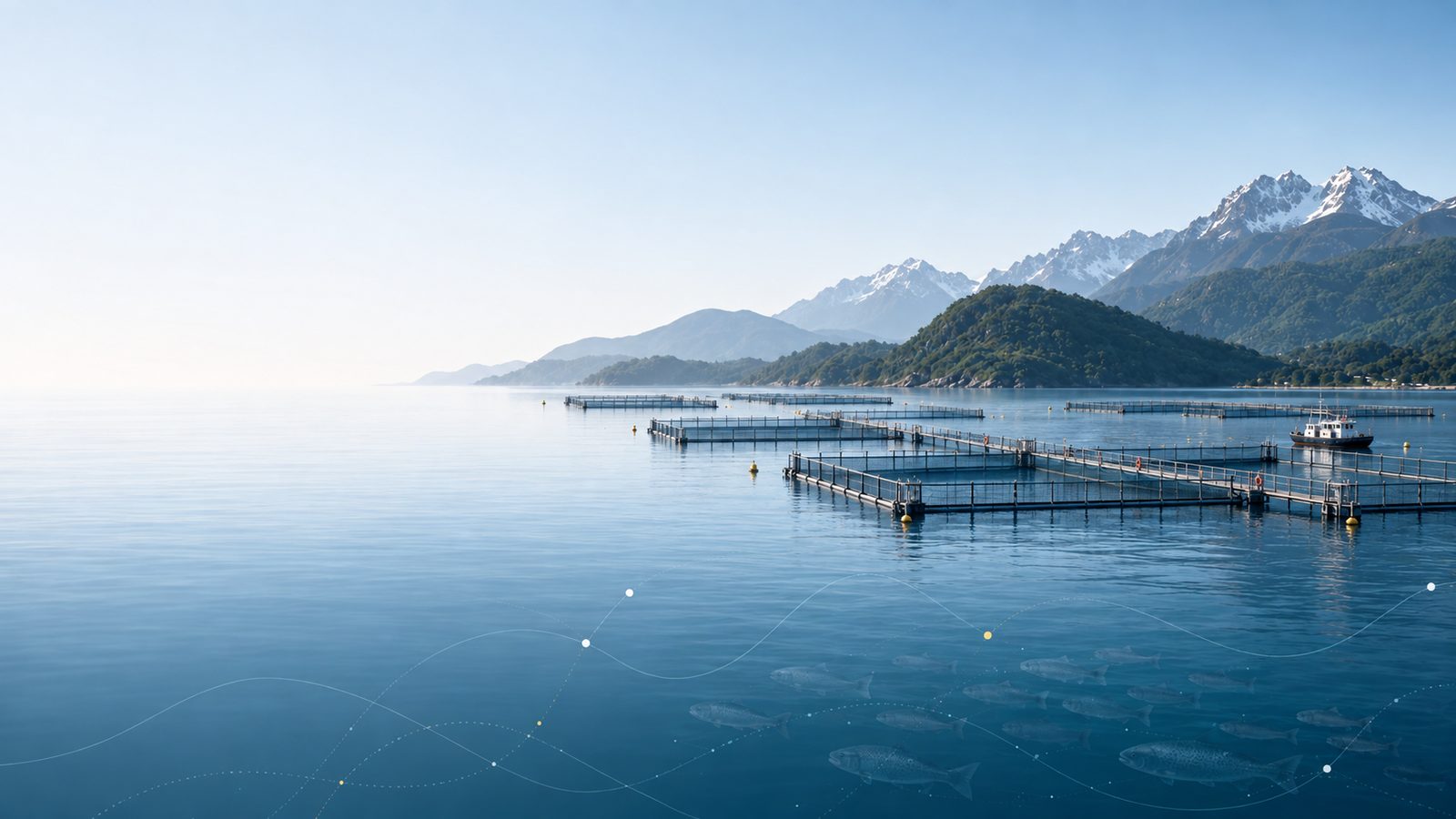
Salmon farming
The salmon's path
A story of vision, science and collaboration.
Chilean salmon farming did not appear overnight. It is the result of more than five decades of learning, research, international cooperation and technological development.
What began as a series of experiments to introduce salmonids to Chile became, over the years, one of the country's most important productive activities and a global benchmark in aquaculture.
This was possible thanks to a combination of favorable natural conditions, public policy, scientific research, private investment and the ability of thousands of people and institutions to keep learning, adapting and innovating.
Why did Chile become a salmon farming powerhouse?
Chile has extensive southern fjords and channels, abundant freshwater resources and environmental conditions suited to farming salmonids. However, these natural advantages alone would not have been enough.
The industry's growth was also made possible by:
- international cooperation during the early stages of development;
- the training of specialized human capital;
- the adoption of new technologies;
- the creation of supplier companies and specialized services;
- stronger logistics and infrastructure;
- the ability to learn from accumulated experience;
- the policies the Chilean State put in place to promote the activity.
Over time, these elements gave rise to a salmon cluster, that is, a network of companies, public institutions, universities, research centers and specialized suppliers that work closely together to drive the development of the activity.
The milestones that shaped this path
The history of salmon farming can be read as a sequence of stages, each of which brought new knowledge and challenges.
Each of these milestones represents a stage of learning that helped build the salmon farming we know today.
Historical production of farmed salmonids in Chile (1990–2024)
| Year | Tonnes |
|---|---|
| 1990 | 35,000 |
| 1991 | 51,000 |
| 1992 | 70,000 |
| 1993 | 89,000 |
| 1994 | 111,000 |
| 1995 | 150,000 |
| 1996 | 210,000 |
| 1997 | 252,000 |
| 1998 | 262,000 |
| 1999 | 261,000 |
| 2000 | 408,000 |
| 2001 | 499,000 |
| 2002 | 490,000 |
| 2003 | 560,000 |
| 2004 | 628,000 |
| 2005 | 659,000 |
| 2006 | 608,000 |
| 2007 | 636,000 |
| 2008 | 617,000 |
| 2009 | 533,000 |
| 2010 | 547,000 |
| 2011 | 719,000 |
| 2012 | 817,000 |
| 2013 | 783,000 |
| 2014 | 950,000 |
| 2015 | 829,000 |
| 2016 | 742,000 |
| 2017 | 864,000 |
| 2018 | 918,000 |
| 2019 | 1,014,000 |
| 2020 | 1,060,000 |
| 2021 | 999,000 |
| 2022 | 1,058,000 |
| 2023 | 1,080,000 |
| 2024 | 998,000 |
A process still underway
The salmon's path does not end with the consolidation of the industry.
Today salmon farming keeps evolving to respond to new challenges related to sustainability, fish welfare, climate change adaptation, technological innovation and responsible food production.
History shows that one of the sector's main strengths has been its ability to learn from experience, incorporate scientific knowledge and turn challenges into opportunities for improvement.