Salmon farming
Global salmon farming
Salmon farming is a chain that runs from broodstock to markets, and a link in world food production.
What is salmon farming?
Salmon farming is an aquaculture activity devoted to the controlled farming of fish in the salmonid group, mainly Atlantic salmon (Salmo salar), coho salmon (Oncorhynchus kisutch) and rainbow trout (Oncorhynchus mykiss), to produce food of high nutritional value.
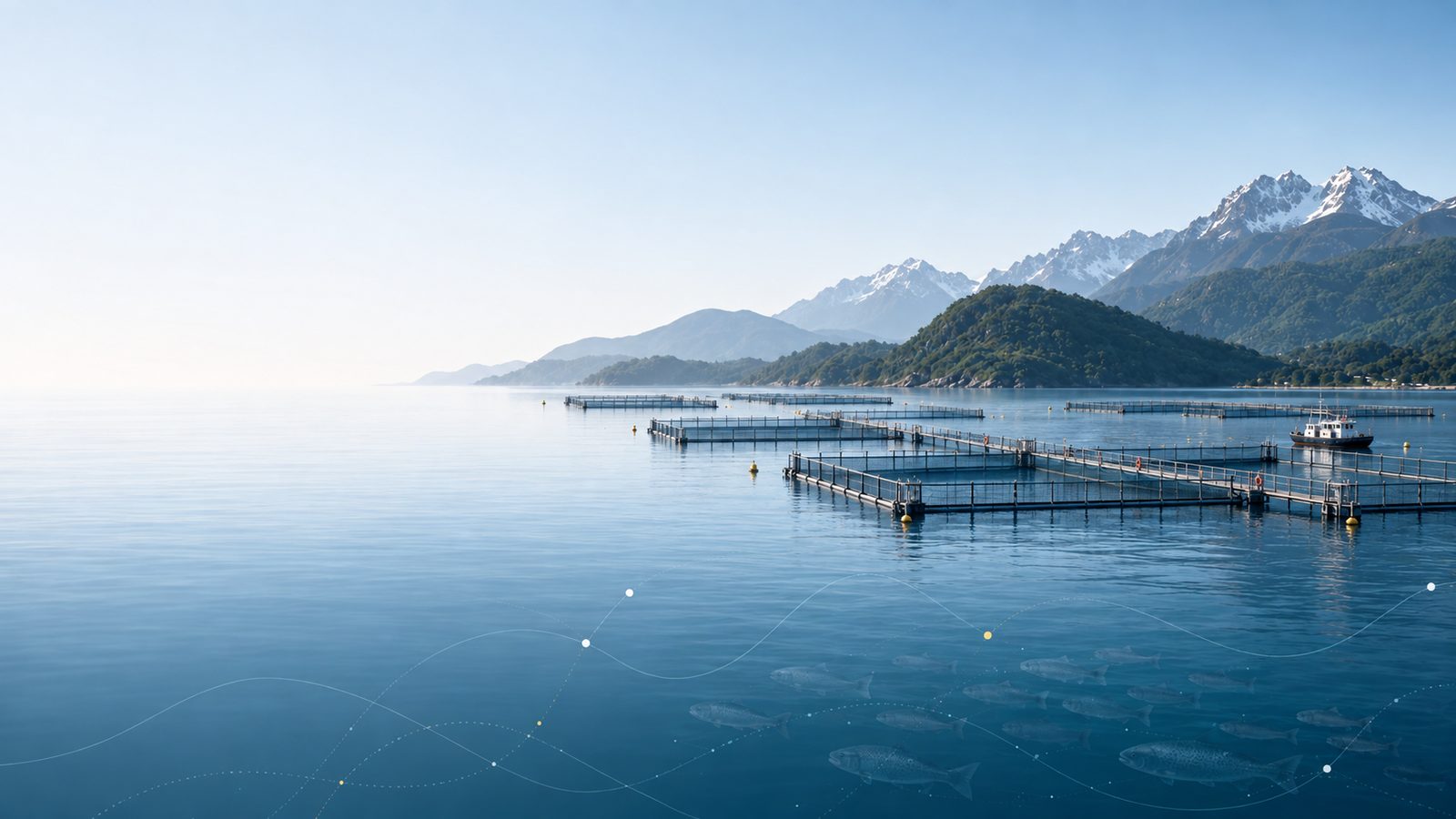
Although it is usually associated with farm sites at sea, it actually covers a much broader production chain. The process includes broodstock management, fertilization and incubation of eggs, rearing of the fish's early stages in freshwater, later grow-out at sea, harvest, processing and distribution to markets. Together, these steps are known as the value chain.
For this reason, salmon farming is not simply about “raising fish.” It brings together knowledge and capabilities in areas such as biology, genetics, nutrition, animal health, fish welfare, engineering, technology, logistics, processing, environmental regulation and international trade.
Many of the farmed species share a key biological trait: they are anadromous. This means that, in the wild, they hatch and go through their first stages in freshwater, migrate to the sea to grow and later return to rivers to spawn. Salmon farming reproduces this cycle under controlled conditions through freshwater facilities and marine farm sites.
An activity tied to the global food system
Salmon farming is part of a broader shift in the way the world obtains food from aquatic environments, as one branch of aquaculture. For many decades, supply depended mainly on fishing wild stocks. However, the growth of aquaculture has made it possible to increase aquatic food production through the controlled farming of fish, mollusks, crustaceans and algae.
In 2022, aquaculture produced 94.4 million tonnes of aquatic animals and, for the first time, overtook capture fisheries, reaching 51% of world production. This shift reflects the growing importance of farming in meeting demand for food from the water.
Within this landscape, salmon holds a particular position. It is not the largest group by volume in world aquaculture, but it is one of the most significant for its economic value, its level of technological sophistication, its presence in international trade and its visibility among consumers.
The expansion of production has also made it possible to keep supply more stable throughout the year and to serve markets on different continents. In this way, salmon stopped being a food associated only with certain cold regions and became a global product.
A biological, technological and territorial activity
Modern salmon farming has developed through the interaction of many advances. These include genetic improvement, aquaculture nutrition, formulated feeds, vaccination, environmental monitoring, automation, cold-chain logistics and the opening of new international markets.
However, its development also depends on the conditions of the areas where it operates. Farming in open systems is influenced by dynamic factors such as temperature, available oxygen, water circulation and the environment's capacity to process organic matter.
Added to these factors are challenges related to fish health and welfare, regulation, use of coastal space, climate change, traceability, market requirements and relations with communities. That is why assessing modern salmon farming means looking not only at how much it produces, but also at how it manages its health, environmental and territorial risks.
Consequently, a complete definition must see it as a biological, technological, economic, food and territorial activity, involving a range of knowledge, infrastructure, institutions and people.